HOW IT WORKS
Two questions that only make sense together.
What does an assistant answer today, and what is that answer built on? GeoVouch keeps these as two separate workflows because they need different evidence — and because either one alone leaves you stuck.
Why it is deliberately not one pipeline
- A prompt result alone is a scoreboard. You were named in 3 of 20 answers. Now what? Without knowing whether a model can read your site, whether your own pages say anything specific, or whether independent sources mention you, there is no next move — only a number that moves on its own.
- A site audit alone is unfalsifiable. Fix your structured data and… did anything change? Without asking the models directly, an audit is a list of best practices with no way to check whether any of it mattered.
- Together they close the loop. The prompt view is the outcome. The product view is the conditions. One tells you where you stand; the other tells you which lever is stuck.
Product GEO Analysis · seven steps

The order is not cosmetic. Each pair answers a question the previous pair cannot:
- Steps 1–2 · can it be read. Identify what product this actually is and which page is really its home, then check whether that page can be crawled, parsed and quoted. Everything downstream is meaningless if this fails. Both are free.
- Steps 3–4 · branded, and split by source. Both search the product's own name. Step 3 scores only first-party evidence; step 4 scores only independent sources. Kept apart because a model weighs “what they say about themselves” and “what others say about them” very differently — blended into one ledger, the question “is this self-promotion or corroboration” becomes unanswerable.
- Steps 5–6 · de-branded, and that is the point. Neither ever uses your name. Step 5 asks whether you surface in category searches at all; step 6 asks how much of the category's comparison coverage is about you. Searching your own brand and finding yourself is a self-fulfilling test — these are the ones a stranger's question actually resembles.
- Step 7 · the only cross-reference. Consistency between what you claim and what third parties confirm can only be computed once both sides exist, which is why it is last rather than folded into either one. Free — it summarises steps already paid for.
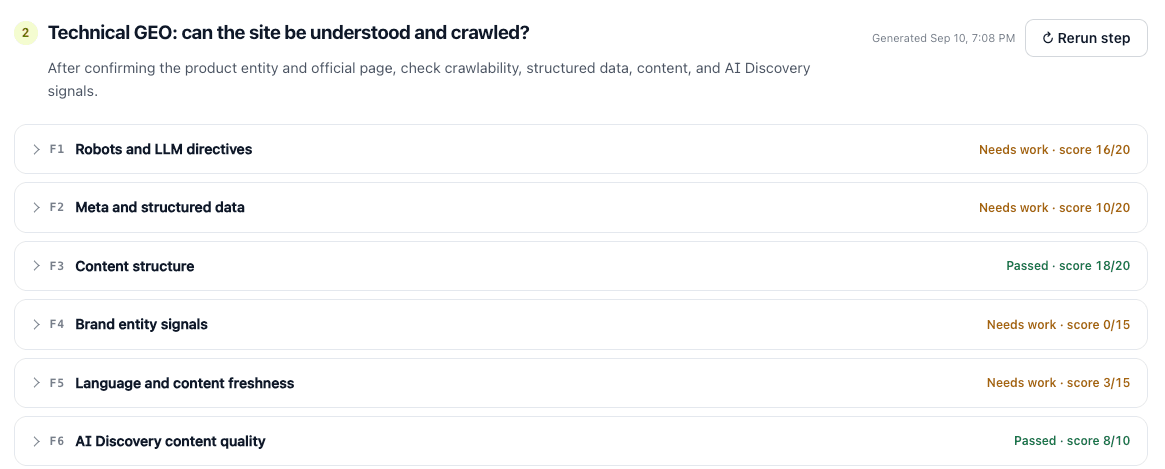
Step 2 — can a machine read the page at all?
Six checks, each scored and each expandable down to the literal text or markup it read. The cheapest kind of problem to have, because it is entirely within your control.
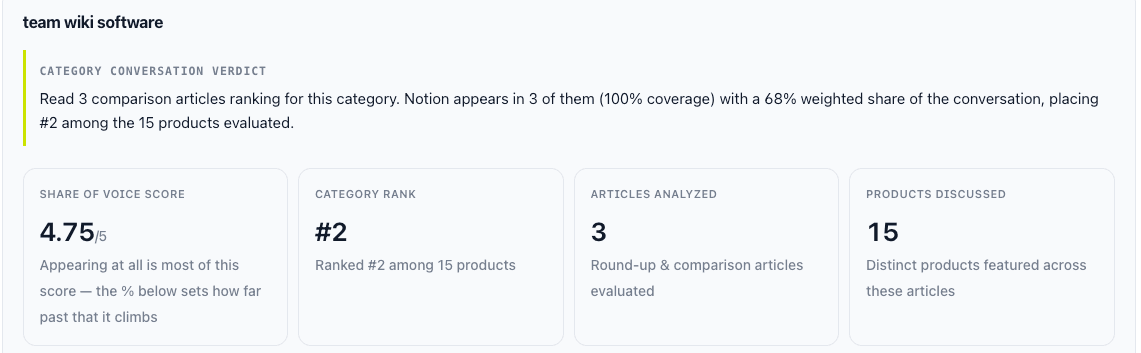
Step 6 — how much of the category's conversation is about you?
The most expensive step and usually the most revealing. It finds the comparison articles and round-ups for your category, reads them, and works out what share of that conversation you occupy — per category, never pooled into one blended number, because different categories do not share a competitor set.
Prompt Result Analysis · four steps
No product to set up. You give it one question, it asks several models that question twice each, and it ranks which products the answers actually named, recommended, and cited.
- Twice per model, on purpose. A single answer is an anecdote. Two independent runs show whether a recommendation is stable or a coin flip.
- Cited sources are captured, not just names. Which pages a model reached for is the part that tells you where to go next — a name in an answer is the symptom, the citation is the address.
- No target product. It does not know or care whose side you are on, so the ranking is not framed around you. What it reports is simply who the answer was about.
What it costs
Charged per step as it runs, with the price on the button that starts it. Stop halfway and you paid for the steps that finished; a step that fails returns its Credits; revisiting a finished step is always free.
- Identify entity, Technical GEO — free
- Official Content, 3rd-Party Content, Category Search Results — 1 Credit each
- Share of Voice — 2 Credits, it searches and reads considerably more
- Final Report — free
- Prompt Result Analysis — 1 Credit per model